Voice Typing for Insurance Agents: Close More Policies | Oravo
How Insurance Agents and Brokers Use Voice Typing to Close More Policies and Serve More Clients
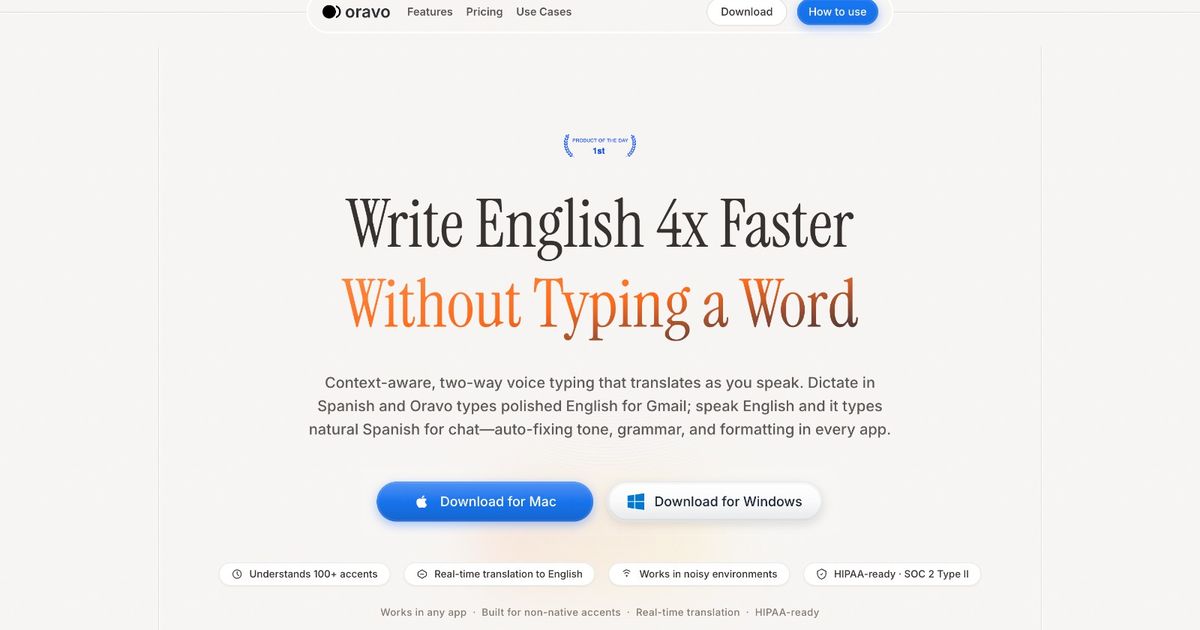
Insurance agents and brokers use voice typing to write client proposals, coverage summaries, follow-up communications, and compliance documentation 4x faster than keyboard typing, capture prospect and client notes immediately after every interaction without losing critical details, produce the professional policy presentations that close more business, and eliminate the after-hours administrative burden that prevents agents from spending their best hours selling. Modern AI voice typing like Oravo delivers 98% accuracy even with insurance terminology, policy language, and coverage specifics, works offline for confidential client financial data, and starts at just $9.99 per month with 2,000 words free every week - making it the tool that top-producing agents and brokers are adopting to grow their books of business without growing their working hours.
Why Voice Typing Benefits Insurance Agents and Brokers
The Administrative Burden That Competes With Selling
Insurance is a sales profession. The agents and brokers who produce the most are the ones who spend the most time in front of prospects and clients - building relationships, identifying needs, presenting solutions, and closing business. Every hour spent on administrative documentation is an hour not spent selling.
Industry research consistently places the administrative burden on insurance agents at 30-40% of total working time. Client meeting notes, proposal preparation, coverage summaries, policy documentation, claims assistance communication, and compliance records all consume time that high-producing agents would rather spend on revenue-generating activity. The agent who types two hours of documentation daily is the agent who makes two fewer prospecting calls, follows up with two fewer warm leads, and closes two fewer policies per week.
Voice typing at 200+ words per minute cuts that administrative time dramatically. An agent who dictates meeting notes, client communications, and proposal content recovers hours weekly that redirect directly to sales activity. The compounding effect on annual production is substantial.
The Speed Advantage in a Competitive Market
Insurance clients shop. A prospect who requests quotes from three agents books with the agent who responds most completely and most quickly. The coverage summary that arrives the same day as the consultation beats the proposal that arrives three days later - even if the coverage and pricing are identical.
Voice typing provides the speed advantage that determines who gets the business. Dictating a coverage summary immediately after a client meeting - before leaving the parking lot, before returning to the office, before the prospect has time to hear from a competitor - changes the competitive dynamics of every prospect interaction.
The agent who produces a thorough, personalized proposal in twenty-five minutes instead of ninety maintains the response speed that wins business at every stage of the sales cycle.
Client Relationship Depth and Retention
Insurance client relationships are long-term. A client who remains with an agent for ten years through multiple policy renewals, coverage updates, life events, and claims is the most valuable client in any book of business. Retaining clients requires ongoing communication that demonstrates genuine attention to their specific situation.
Agents who communicate thoroughly - who send annual coverage review summaries, who follow up proactively on life events that affect coverage needs, who check in during claims processes, who remember and reference specific client circumstances in their communications - retain clients at dramatically higher rates than agents who communicate only at renewal time.
Voice typing enables the quality and frequency of client communication that builds retention without consuming the selling time that drives production.
Compliance Documentation and Regulatory Requirements
Insurance is a heavily regulated industry. Agents and brokers must maintain documentation of client interactions, coverage recommendations, disclosure compliance, and needs analysis that demonstrates their professional obligations were met. This compliance documentation is not optional and its adequacy is tested during regulatory audits and errors and omissions claims.
Agents who maintain thorough, timely compliance documentation protect themselves professionally. Voice typing enables compliance documentation that is both more complete and more timely than typed documentation produced under production pressure. Notes dictated immediately after client meetings capture the actual conversation rather than a compressed reconstruction produced hours later.
Voice Typing Use Cases for Insurance Agents and Brokers
Client Needs Analysis and Meeting Notes
The client needs analysis is the foundation of appropriate coverage recommendations. Documenting a client's risk profile, coverage needs, existing coverage, financial situation, and stated preferences creates the record that supports coverage recommendations and satisfies compliance requirements simultaneously.
Needs analysis dictation workflow: Immediately after completing a client needs analysis meeting, activate Oravo and dictate the full record: the client's background and risk profile as discussed, the coverage needs identified through the conversation, the existing coverage in place and any gaps identified, the client's stated priorities and budget parameters, the coverage options presented and the rationale for each, the client's response to recommendations, and the agreed next steps. This dictation takes eight to twelve minutes and creates a compliance-ready record of the interaction.
Meeting notes timing comparison:
- Typed meeting notes produced next morning: 25 minutes, 65% accuracy of conversation
- Dictated meeting notes immediately after meeting: 8 minutes, 95% accuracy of conversation
- Annual time savings across 400 client interactions: 110 hours recovered
Coverage Summaries and Policy Presentations
Coverage summaries are the documents that help clients understand what they are buying. A well-written coverage summary that translates policy language into clear explanation of what is covered, what is excluded, what the client's obligations are, and what happens in a claim situation builds client confidence and reduces post-purchase confusion that generates complaints and cancellations.
Coverage summary dictation approach: After preparing a policy recommendation, dictate the coverage summary speaking as if explaining the policy to the client in person. Describe what the policy covers in plain language, the key exclusions the client should understand, the premium and payment structure, the claims process, and the value of the coverage relative to the client's specific risk exposure. The resulting summary is more readable and more useful to clients than summary templates that are not personalized to their situation.
Policy comparison presentations: Clients evaluating multiple coverage options benefit from written comparison presentations that allow them to review options at their own pace. Dictating comparison presentations - speaking through each option's coverage, cost, carrier strength, and fit with the client's specific situation - produces more complete and more persuasive comparisons than typed versions produced under time pressure.
Prospect Follow-Up and Pipeline Management
Insurance sales require persistent, professional follow-up. Prospects who do not buy on the first presentation respond to follow-up at rates that make continued contact one of the highest-ROI activities in insurance sales. The agent who follows up consistently - with relevant, personalized communications rather than generic check-ins - closes significantly more business from their prospect pipeline.
Follow-up communication dictation: After each prospect interaction, dictate the follow-up communication while the conversation is fresh. Reference the specific concerns the prospect raised, the specific coverage options discussed, and the specific next step agreed. A personalized follow-up that demonstrates genuine attention to the prospect's situation converts at dramatically higher rates than generic follow-up templates.
Pipeline notes: Maintaining accurate, complete pipeline notes enables agents to pick up prospect relationships weeks or months after the initial contact without losing the thread of the relationship. Dictating comprehensive pipeline notes immediately after each interaction ensures the relationship context is preserved for future follow-up.
Claims Assistance Documentation
Agents who help clients navigate claims build the relationship loyalty that prevents switching at renewal. Claims are the moments when clients discover whether their insurance actually delivers what they expected. An agent who is present, helpful, and well-documented during claims processes becomes the agent clients trust for life.
Claims assistance dictation: Document every client interaction during a claims process - the client's account of the loss, the coverage analysis applied to the loss, the guidance provided, the referrals made, and the follow-up committed. This documentation serves both compliance and relationship purposes: it demonstrates the agent's professional involvement and creates the record that protects both the client and the agent if the claim is disputed.
Claims follow-up communications: Dictating follow-up communications during claims processes - checking on the client's experience, providing guidance on next steps, and demonstrating ongoing involvement - produces the genuine, personal communications that build the loyalty that survives renewal.
Annual Review and Renewal Communications
Annual policy reviews are the highest-value client service activity in insurance. A thorough annual review identifies coverage gaps created by life changes, confirms coverage remains appropriate for the client's current situation, demonstrates the agent's ongoing attention, and creates the opportunity to add coverage and increase the client's value to the book.
Annual review preparation: Before each annual review, dictate a preparation summary: the client's current coverage, any life changes noted since the last review, market changes that might affect coverage recommendations, and specific questions to address during the review. This preparation ensures the review is productive rather than perfunctory.
Post-review summary: Immediately after the annual review meeting, dictate a comprehensive summary: coverage confirmed, changes made, coverage gaps identified, recommendations accepted or declined, and next steps. This summary serves as both the compliance record of the review and the client communication that memorializes the meeting's conclusions.
Referral Requests and Center-of-Influence Communication
Referrals are the most efficient source of new business in insurance. A referred prospect arrives with built-in trust, converts at higher rates, and typically has a longer retention profile than cold prospects. Generating referrals requires deliberate, ongoing communication with both clients and centers of influence - accountants, attorneys, financial advisors, and other professionals who work with the same client base.
Referral request dictation: After successful client interactions - a claim resolved well, an annual review with significant value added, a new coverage placement that solved a genuine problem - dictate a referral request that acknowledges the specific positive experience and makes the referral ask naturally and personally. A referral request that references the specific value delivered converts at dramatically higher rates than generic referral requests.
Center-of-influence communication: Maintaining relationships with referral sources requires ongoing professional communication - updates on shared clients (within appropriate confidentiality), industry news relevant to the COI's clients, and periodic relationship maintenance contact. Voice typing enables this communication at the frequency that maintains relationships without consuming the selling time that direct prospecting requires.
Commercial Lines Documentation
Commercial insurance agents and brokers produce more documentation-intensive work than personal lines counterparts. Commercial risk assessments, coverage proposals for complex accounts, certificates of insurance management, and renewal presentations for large accounts all require substantial written output.
Commercial account proposals: A commercial insurance proposal for a mid-market account might require a risk assessment narrative, coverage recommendation rationale for multiple lines, carrier selection justification, premium comparison analysis, and claims management consultation description. Dictating this proposal immediately after the account submission process - while the account's specifics are fresh - produces a more complete and more competitive proposal than typed versions compressed under submission deadlines.
Risk assessment narratives: Commercial risk assessments require describing the insured's operations, identifying specific risk exposures, evaluating existing risk management practices, and recommending coverage and risk management improvements. Dictating risk assessment narratives speaking as if briefing an underwriter produces thorough, operationally specific assessments that improve placement outcomes.
Best Voice Typing Tools for Insurance Agents and Brokers
Oravo AI: Best Overall for Insurance Professionals
Oravo provides the combination of accuracy, offline capability, mobile functionality, and cross-application support that insurance sales and service requires. For agents who work across agency management systems, CRM platforms, email, and mobile devices simultaneously, Oravo's consistent performance across all environments is essential.
Why Insurance Agents Choose Oravo:
98% accuracy with insurance terminology: Policy language, coverage terminology, carrier names, and insurance industry vocabulary all transcribe accurately. Add client names, specific policy numbers and types, and carrier-specific terminology to the custom dictionary for comprehensive accuracy across your specific book of business.
Offline mode for confidential client financial data: Client financial information, health data, and coverage details are sensitive and confidential. Oravo's offline mode ensures dictated client information never transits cloud servers. For agents with compliance obligations around client data handling, offline mode provides the assurance that client information stays on the device.
Works across all agency tools: Oravo works in Applied Epic, Vertafore, Salesforce, HubSpot, and every other agency management system and CRM with text input fields. No workflow changes required - dictate directly into whatever system you are already using.
Mobile functionality for field agents: Life and health agents who meet clients in their homes, commercial agents who conduct on-site risk assessments, and benefits consultants who work at employer locations all need mobile documentation capability. Oravo's iOS and Android apps deliver full accuracy from a smartphone in any field environment.
Free tier for new agents: 2,000 words per week free forever covers agents building their practice who use voice typing selectively. The free tier is permanent, not a trial.
$9.99 per month for full production use: Agents managing active books with daily client and prospect interactions benefit from the unlimited paid tier. Recovering ninety minutes of daily administrative time returns the investment within the first morning of the first week.
Google Docs Voice Typing: Free but Single-Application
Works only in Google Docs via Chrome browser. Agents who work across agency management systems, CRM platforms, and email cannot use Google Docs Voice Typing without disruptive workflow interruptions. Insufficient for the multi-application reality of insurance practice.
Apple Dictation and Windows Speech Recognition: Free but Below Professional Standard
Built-in OS dictation provides 85-92% accuracy adequate for casual use but below the standard for professional client-facing insurance documentation. Policy names, carrier terminology, and coverage-specific language accuracy is poor without customization. No offline mode for client data protection.
Best for: Testing the voice typing concept before adopting Oravo.
How Insurance Agents and Brokers Set Up Voice Typing
Quick Setup for Oravo (10 Minutes)
Step 1: Install on both phone and desktop (2 minutes) Insurance agents need voice typing on both devices. Field agents need mobile capability for client meeting notes. Office-based agents need desktop capability for proposal and correspondence production. Install both before using either.
Step 2: Build your insurance vocabulary (5 minutes) Add insurance-specific vocabulary: carrier names you place business with regularly, specific policy types and coverage names, industry terminology specific to your lines of business, client names for your top accounts, and any agency-specific language or product names. This vocabulary investment produces immediate accuracy improvement on the terminology you use most.
Step 3: Enable offline mode for client data (1 minute) Enable offline mode before dictating any client-specific information. Insurance client data is sensitive and compliance-governed. Offline mode ensures it stays on the device.
Step 4: Dictate your next client meeting notes (2 minutes) After your next client interaction, dictate the meeting notes immediately with Oravo. Compare the result to your normal note-taking process. Most agents are committed to voice typing after their first real-use session.
Insurance Agency Workflow Integration
The post-meeting dictation habit: Every client or prospect interaction should end with a five-minute dictation session. Before your next call, before checking messages, before driving away from the client's location - dictate the notes. This habit produces better compliance records, better follow-up quality, and better pipeline management simultaneously.
The proposal dictation session: Block time for proposal production using voice typing. With typing, producing three thorough proposals takes a full afternoon. With voice typing, the same three proposals take ninety minutes. The recovered time goes directly to prospecting and relationship-building activity.
Weekly production time comparison:
- Typed administrative work: 15-20 hours weekly
- Dictated administrative work: 6-8 hours weekly
- Time recovered for sales activity: 8-12 hours weekly
- Annual production impact at typical close rates: significant additional premium volume
Professional Insurance Communication with Voice Typing
Writing Proposals That Close More Business
Insurance proposals win business when they demonstrate three things: understanding of the prospect's specific risk situation, a coverage solution that addresses that situation specifically, and the agent's professional credibility and service commitment. Generic proposals that could apply to any prospect in the same industry category lose to specific proposals that reflect genuine understanding of the individual prospect's circumstances.
Voice typing enables specific proposals because dictating immediately after a prospect consultation captures the specific language the prospect used, the specific concerns they raised, and the specific risk factors that distinguish their situation. That specificity, reflected in the proposal, demonstrates the listening quality that prospects buy from.
Coverage Explanations That Reduce Cancellations
Insurance cancellations and lapses occur most often when clients do not understand what they bought, feel the coverage does not deliver value, or experience a claims problem that was not explained at the time of purchase. Written coverage explanations that clearly communicate what the policy covers, what the client's obligations are, and what to expect during a claim reduce post-purchase confusion that drives cancellations.
Dictating coverage explanations in plain language - speaking as if explaining the policy to the client over the phone - produces more accessible, more useful coverage communications than policy language reproduced from carrier documents. Clients who understand their coverage renew. Clients who do not understand their coverage cancel.
Compliance Documentation That Protects the Agent
Errors and omissions claims against insurance agents most commonly involve disputes about what was discussed, what was recommended, and what the client understood at the time of purchase. Agents with thorough, contemporaneous documentation of client interactions have substantially better protection than agents with sparse or retrospective records.
Voice typing enables the thoroughness and timeliness of compliance documentation that protects agents professionally. A meeting note dictated within fifteen minutes of a client interaction captures the actual conversation with a completeness that notes typed from memory the following morning cannot match. Over a career, that documentation quality is the difference between E&O claims that resolve quickly and E&O claims that damage practices.
Voice Typing for Different Insurance Roles
Personal Lines Agents
Personal lines agents serving individuals and families with auto, home, life, and umbrella coverage manage high volumes of relatively standardized transactions with significant client communication requirements. The combination of high transaction volume and thorough communication expectations makes voice typing particularly valuable for personal lines productivity.
Personal lines agents who adopt voice typing for client communication - coverage summaries, renewal communications, claims assistance notes, and annual review summaries - maintain the communication quality that builds retention across large books without the administrative burden that typically accompanies high-volume service.
Commercial Lines Agents and Brokers
Commercial lines professionals manage more complex accounts with higher documentation requirements than personal lines counterparts. Risk assessment narratives, coverage proposals spanning multiple lines, certificate management, and renewal presentations for large accounts all generate substantial written output.
Commercial agents benefit most from voice typing for proposal production and risk assessment documentation - the highest-value, highest-word-count documents in commercial insurance practice. A commercial account proposal that demonstrates deep understanding of the insured's operations and risk profile wins business. Producing that quality of proposal requires both technical knowledge and writing time. Voice typing reduces the time barrier without reducing the quality requirement.
Life and Health Agents
Life and health agents conduct needs analysis conversations that are among the most personal interactions in financial services. Documenting these conversations thoroughly - the client's family situation, financial circumstances, health concerns, and protection priorities - creates both compliance records and the relationship context that enables genuinely consultative service over time.
Life and health agents who dictate needs analysis documentation immediately after client meetings capture the emotional context and specific personal details that distinguish a client relationship from a transaction. That documentation, reviewed before each subsequent interaction, enables the genuinely personal service that generates referrals and multi-policy relationships.
Employee Benefits Brokers
Benefits brokers manage employer group accounts that require enrollment documentation, employee communication support, plan comparison presentations, and renewal analysis. The documentation volume per account is high and the communication quality expected by employer clients is professional and thorough.
Benefits brokers use voice typing for renewal presentations, plan comparison narratives, and employer communication support. The ability to produce a thorough renewal analysis - comparing current plan performance, market alternatives, cost trends, and recommendation rationale - in a fraction of the typing time improves both the quality of renewal presentations and the broker's capacity to manage more accounts.
Independent Agents and Brokers
Independent agents and brokers who represent multiple carriers bear the full documentation burden without the administrative support that captive agent systems sometimes provide. Every proposal, every client communication, every compliance record is produced by the agent personally.
Voice typing provides independent agents with the efficiency advantage that allows them to compete on service quality with larger operations. The independent agent who produces same-day proposals, comprehensive coverage summaries, and thorough follow-up documentation competes favorably against captive agents with administrative support - and often wins on the personal service quality that independence enables.
Insurance Agent and Broker Success Stories
Case Study: Personal Lines Agent with 800-Policy Book
The situation: Robert was a personal lines agent with an 800-policy book of business managing renewals, new business development, and client service simultaneously. His documentation burden - meeting notes, coverage summaries, renewal communications, and compliance records - was consuming 3-4 hours daily.
Before voice typing:
- 3-4 hours daily on administrative documentation
- Meeting notes produced next morning from memory
- Coverage summaries abbreviated due to time pressure
- New business prospecting averaging only 5-6 hours weekly
- Book growth stalled due to time allocation constraints
After Oravo (3 months):
- Administrative documentation reduced to 90 minutes daily
- Meeting notes dictated immediately after every interaction
- Coverage summaries thorough and personalized for every new policy
- New business prospecting increased to 10-12 hours weekly
- Book grew from 800 to 950 policies in the following six months
"I knew I needed to prospect more but I never had the time. I thought my book was at capacity. Voice typing showed me my time was at capacity, not my capacity for clients. The extra five hours of selling time every week translated directly into policy growth."
Case Study: Commercial Lines Broker at an Independent Agency
The situation: Maria was a commercial lines broker at a 12-person independent agency managing a $2.8 million premium book across 85 commercial accounts. Her renewal season required producing detailed renewal presentations for every account simultaneously, creating a documentation crunch that consumed her team's capacity for months.
Before voice typing:
- Renewal presentations taking 3-4 hours each to produce
- Renewal season requiring significant overtime across the team
- Proposal quality inconsistent due to time pressure
- Three accounts lost in previous renewal season, partially attributed to proposal quality
- Business development essentially stopped during renewal season
After Oravo (team adoption, 4 months):
- Renewal presentations produced in 60-90 minutes each
- Renewal season managed without overtime
- Proposal quality consistent and thorough across all 85 accounts
- Zero accounts lost in following renewal season
- Business development continued through renewal season for the first time
"Renewal season used to feel like an emergency every year. We knew what needed to be done but we never had enough time to do it properly. Voice typing gave us the time. The quality of our renewal presentations improved and so did our retention. Those are connected."
Case Study: Life Insurance Agent Building an Independent Practice
The situation: Priya had left a captive agency to build an independent life insurance practice eighteen months prior. She was seeing 8-10 prospects weekly but her proposal production and follow-up documentation were inconsistent, affecting her close rate and referral generation.
Before voice typing:
- Proposals taking 90 minutes to produce
- Follow-up communications often delayed 2-3 days
- Meeting notes abbreviated or produced from memory the following morning
- Close rate of 28% on qualified prospects
- Referral rate of 15% of closed clients
After Oravo (3 months):
- Proposals produced in 25-30 minutes and delivered same day as consultation
- Follow-up communications same-day for every prospect interaction
- Meeting notes dictated immediately after every consultation
- Close rate improved from 28% to 41% on qualified prospects
- Referral rate improved from 15% to 31% of closed clients
"My close rate improvement was almost entirely from proposal speed. I was losing prospects to agents who responded faster. My coverage and pricing were competitive but they heard from someone else first. Same-day proposals changed that. The referral improvement came from better follow-up. Both came from voice typing."
Case Study: Employee Benefits Broker Managing 40 Group Accounts
The situation: David managed 40 employer group accounts as a benefits broker at a regional brokerage. His accounts ranged from 15 to 300 employees, and each required annual renewal analysis, plan comparison presentations, and ongoing employee communication support. The documentation volume was manageable until renewal seasons compressed multiple deadlines simultaneously.
Before voice typing:
- Renewal analysis documents taking 4-5 hours per account
- Employee communication support limited due to time constraints
- Renewal season requiring 60+ hour weeks for two months annually
- Client satisfaction scores noting communication frequency as below expectation
- Two accounts lost in previous year to brokers perceived as more attentive
After Oravo (3 months):
- Renewal analysis documents produced in 90-120 minutes per account
- Employee communication support available to all 40 accounts
- Renewal season managed in normal working hours
- Client satisfaction scores improved, with communication specifically cited
- Both previously lost accounts re-approached and one re-won
"Benefits clients measure their broker by how available and responsive they are throughout the year, not just at renewal. Voice typing gave me the time to be that broker for all 40 accounts instead of just the largest ones. That changed my retention and my reputation."
Frequently Asked Questions
Is voice typing with offline mode appropriate for handling confidential client insurance information?
Oravo's offline mode processes all audio on-device with no cloud transmission, which means dictated client information - financial data, health information, coverage details - never leaves the device. For insurance agents with compliance obligations around client data handling, offline mode provides this assurance. Agents should review their specific compliance obligations and their agency's data handling policies. Offline mode eliminates cloud transmission risk; device security practices protect the data once transcribed.
How does Oravo handle insurance-specific terminology like policy types, carrier names, and coverage language?
Oravo achieves 98% accuracy on standard insurance vocabulary. For carrier-specific product names, proprietary coverage terminology, and client-specific information, adding these to the custom dictionary takes five minutes and produces immediate accuracy improvement. Most agents spend five to ten minutes building their insurance vocabulary dictionary and achieve excellent accuracy throughout their daily documentation work.
Can I use voice typing during client meetings to capture notes in real time?
Most agents prefer to dictate immediately after meetings rather than during them, because dictating during a meeting divides attention and can make clients feel they are being recorded rather than heard. The immediate post-meeting dictation approach - five to eight minutes immediately after the client leaves or the call ends - captures the interaction with high accuracy and produces better compliance documentation than real-time transcription attempted while also managing the conversation.
How does voice typing help with the compliance documentation requirements of insurance practice?
Compliance documentation requires two qualities: completeness and timeliness. Completeness means the record captures what was discussed, what was recommended, what alternatives were presented, and what the client understood and decided. Timeliness means the record is created at or near the time of the interaction rather than reconstructed later. Voice typing enables both qualities simultaneously - dictating immediately after a client interaction produces documentation that is more complete and more timely than typed notes produced at end of day or the following morning.
Can voice typing help with producing insurance certificates and standard forms?
Voice typing is most effective for narrative documentation - meeting notes, coverage summaries, proposals, and correspondence - rather than structured forms with fixed fields. Insurance certificates and standard forms are typically completed through agency management systems with their own data entry workflows. The highest-value application of voice typing for certificate management is the accompanying cover letters and explanatory communications, which benefit from dictation, while the certificates themselves are populated through standard system workflows.
How does voice typing affect the quality of client communication over time?
Agents who use voice typing consistently report that their client communication quality improves alongside its speed. The reduced friction of dictation encourages more frequent, more thorough, and more personalized communication. Clients who receive more complete, more personally attentive communication feel better served, renew at higher rates, and refer more consistently. The improvement in client communication quality is often the most significant long-term benefit of voice typing adoption in insurance practice.
Is voice typing helpful for producing scripts and talk tracks for prospecting calls?
Yes. Many agents use voice typing to dictate prospecting call scripts, objection response guides, and presentation frameworks. Speaking the script in a natural, conversational voice produces more authentic call language than scripts typed in formal prose. Dictated scripts tend to sound like the agent actually speaks rather than like marketing copy, which improves their effectiveness in live prospecting conversations.
What is the best way to integrate voice typing into an agency management system like Applied Epic or Vertafore?
Oravo works in any text input field in Applied Epic, Vertafore, and other agency management systems. Position your cursor in the activity note, the client communication field, or the documentation area of your AMS, activate Oravo, and dictate. The text appears in the AMS exactly as if you had typed it. No integration or configuration is required beyond the standard Oravo setup.
How does voice typing help with managing a large book of business during renewal season?
Renewal season compresses high documentation demands into a concentrated time period. Voice typing reduces the per-renewal documentation time - renewal analysis narratives, renewal presentation documents, client communication - by more than half. An agency that adopts voice typing before renewal season enters that period with substantially more documentation capacity than in prior years, enabling higher quality renewal presentations for more accounts without additional hours.
Is the free tier sufficient for insurance agents?
The free tier of 2,000 words per week covers light use - perhaps two or three meeting notes and some correspondence weekly. Agents with active books managing daily client interactions will exhaust the free tier within one to two days. The $9.99 per month plan is the appropriate choice for full-time insurance practice. At that investment, recovering ninety minutes of daily documentation time returns the cost within the first morning of the first week.
Start Writing More Business with Voice Typing
Transform your insurance practice with voice typing. Write proposals, coverage summaries, meeting notes, and compliance documentation 4x faster, respond to prospects faster than your competition, and reclaim the selling hours that administrative work has been consuming.
Try Oravo AI free (no credit card required):
- 2,000 words per week free forever
- 98% accuracy for insurance terminology and policy language
- Offline mode for confidential client financial data
- Works in Applied Epic, Vertafore, Salesforce, and all agency systems
- Mac, Windows, iOS, Android