How to Use Voice Dictation to Brainstorm Ideas Faster (2026)
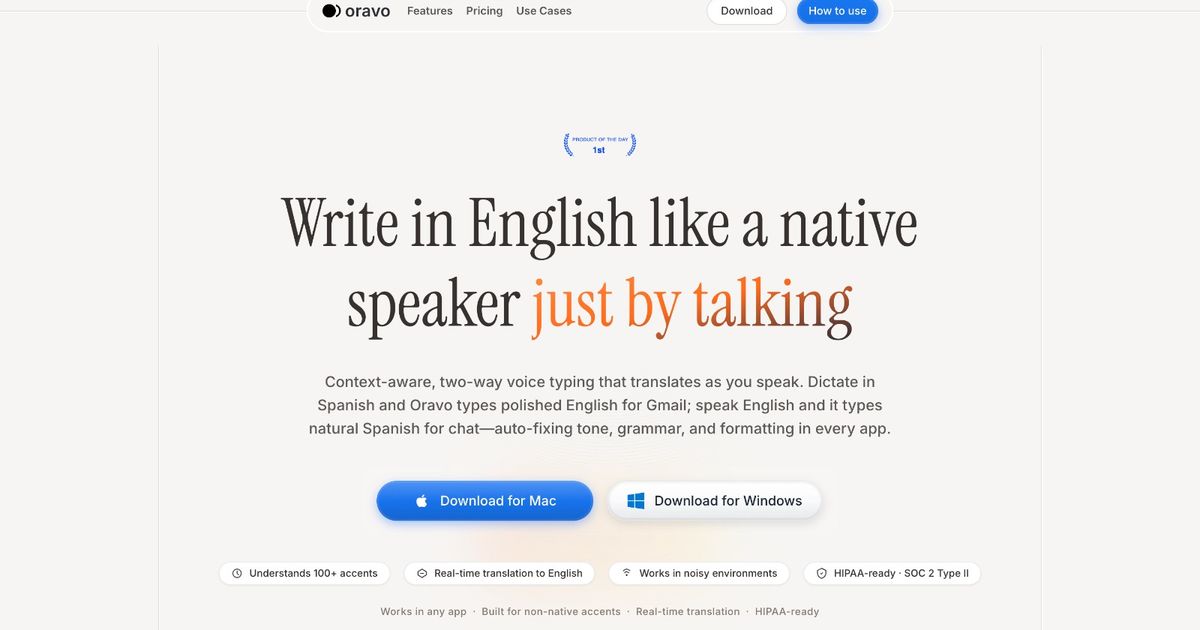
To brainstorm faster using voice dictation, speak your ideas without stopping or self-editing -- the way you would think out loud to a trusted colleague. Voice dictation at 130 words per minute captures ideas three times faster than typing, and the spoken mode bypasses the internal editor that slows written brainstorming. For non-native English thinkers who generate ideas in their native language, Oravo converts spoken input -- including code-switching and mixed-language thinking -- into clean English text, so the brainstorm captures your actual thinking rather than only the ideas that survived translation.
Why Brainstorming by Voice Works Better Than Typing
Every creative and strategic professional has experienced the same frustration: you have more ideas in your head than you can get onto the page before they disappear. You type one, reach for the next, and the one after that is already gone.
The problem is not that you do not have enough ideas. The problem is that typing is too slow to keep pace with thinking. Your brain generates at the speed of conversation. Your fingers type at 40 words per minute. Ideas queue up, compete for attention, and the weaker ones evaporate while you are encoding the stronger ones.
Speaking closes that gap. At 130 words per minute, speaking keeps pace with thinking in a way that typing cannot. The ideas that would have evaporated while you were typing the previous one get captured instead.
But there is a second, less obvious reason that spoken brainstorming produces more ideas than typed brainstorming: speaking bypasses the internal editor more effectively than typing does.
When you type a brainstorm, you see each word as it appears on the screen. The visual feedback of written text activates evaluation -- you read the idea as you type it, you judge it, and many ideas are deleted before they are fully formed because the evaluation happens in the same cognitive moment as the generation. The ideas that survive to the page are the ones that passed the internal editor's first review. That filter eliminates weak ideas, but it also eliminates the wild, unexpected, half-formed ideas that sometimes contain the seed of something genuinely new.
When you speak a brainstorm, the words disappear into the air as you say them. There is no visual feedback to evaluate. The internal editor has less to grab onto. Ideas that would have been deleted before they finished being typed get said -- fully formed, partially formed, or barely formed -- and the dictation tool captures them. The brainstorm is rawer, wilder, and more generative.
Voice dictation for brainstorming is not just faster. It is structurally more generative. That is why professionals who switch to spoken brainstorming consistently report that they produce more ideas per session and encounter unexpected connections that typed brainstorming did not surface.
The Core Technique: Spoken Free Association
The most effective voice dictation brainstorming technique is a spoken version of free association -- continuous speech without filtering, editing, or evaluating what comes out.
The rules are simple:
Speak without stopping. The moment you stop speaking to think, the brainstorm stalls and the internal editor takes over. If you do not know what to say next, say that: "I do not know where to go from here but I am thinking about..." and continue from wherever that takes you.
Do not evaluate while speaking. Every idea that comes out of your mouth gets captured. You will evaluate later. Right now, nothing is too obvious, too strange, too vague, or too obvious to say.
Follow the connections. When speaking produces a word or idea that connects to something else, follow the connection immediately. "I am thinking about X which reminds me of Y which is interesting because Z..." The connections your brain makes in real time are the raw material of insight. Follow them.
Set a timer. A 10 to 15 minute uninterrupted spoken free association session produces a quantity of raw material that hours of typed brainstorming often does not match. The time constraint also removes the pressure of feeling like the brainstorm needs to be comprehensive. You are generating material for 15 minutes. That is the entire commitment.
Five Specific Brainstorming Techniques by Voice
Technique 1: The Spoken Brain Dump
Use this when: You need to clear everything from your head about a topic before you can think clearly about it.
How it works: Activate Oravo in a fresh document. Set a 10-minute timer. Speak everything you know, think, feel, wonder, and assume about the topic. Do not organize. Do not filter. Do not explain. Just empty the mental buffer onto the page.
"The project is behind schedule. I think the issue is the brief was unclear from the start. Sarah has been uncertain about scope. The client has changed their mind three times. The budget conversation has not happened. There is a team meeting Thursday. I do not know if Thursday is too late. The deliverable was supposed to be a prototype but nobody has confirmed what level of fidelity..."
Stop after 10 minutes. What you have produced is a complete inventory of your mental state on the topic -- all the concerns, uncertainties, known facts, and unknowns that are occupying cognitive space. This inventory is more valuable than it looks because it makes the hidden assumptions and concerns visible where they can be addressed rather than influential but invisible.
Technique 2: The Question Storm
Use this when: You need to reframe a problem or find new angles on a challenge.
How it works: Speak questions only. No answers. No statements. Only questions about the topic for 10 minutes.
"What if the approach is wrong at the root level? What would the opposite of what we are doing look like? Who is the person most harmed by the current situation? What would they say about it? What has been tried before? Why did it not work? What constraint are we assuming that might not be real? What does success look like in five years? In five weeks? What would have to be true for this to be easy? What is the single most important thing we do not know yet?"
The question storm generates angles of inquiry that statement-based brainstorming misses. Questions are also lower-friction than statements because they do not claim to be correct -- they are inherently exploratory, which makes the internal editor less likely to intervene.
Technique 3: The Six Perspectives Dictation
Use this when: You need to evaluate an idea or decision from multiple angles.
How it works: Speak for two minutes from each of six different perspectives on the topic. The customer's perspective. The competitor's perspective. The most skeptical critic's perspective. The most enthusiastic advocate's perspective. The perspective of someone who has never heard of this before. Your own honest perspective after hearing all the others.
Six perspectives dictated at two minutes each produces twelve minutes of raw material covering the topic from angles that a single-perspective typed analysis rarely reaches. The perspective-shifting also surfaces objections and considerations that the primary analytical mode tends to suppress.
Technique 4: The Analogy Hunt
Use this when: You are stuck on how to explain, frame, or approach something.
How it works: Speak analogies. "This is like... This reminds me of... It works the way that... The relationship between X and Y here is similar to the relationship between..."
Analogies are one of the most productive brainstorming tools in any domain because they import structure from a familiar domain into an unfamiliar one. Speaking analogies is faster than writing them because the spoken mode is more associative -- the brain finds analogies faster in speech than in writing.
Some of the analogies you produce will be wrong or weak. Some will be illuminating. The editing pass identifies which is which. The brainstorm pass generates as many as possible.
Technique 5: The Constraint Removal Exercise
Use this when: Your brainstorming keeps producing the same ideas because you are thinking within the same constraints.
How it works: Speak your brainstorm under imaginary constraint removal. "If budget were not a constraint, I would..." "If we had twice as much time, the approach would be..." "If the team were three times larger..." "If the client had no preconceptions..." "If we were starting completely from scratch..."
Constraint removal produces ideas that would not survive the realism filter of normal brainstorming. Some of them are genuinely impractical. Some reveal a direction that is achievable through a different route than the removed constraint implied. The exercise also reveals which constraints are real and which are assumed -- a valuable distinction that normal brainstorming obscures.
How Oravo Specifically Changes the Brainstorming Experience
Standard dictation tools produce raw transcription. For brainstorming, this is partially acceptable -- you want raw material, not polished prose. But raw transcription from non-native English speech presents a specific challenge: the brainstorm captures the translation artifacts as well as the ideas.
When a multilingual thinker brainstorms by voice, two things happen simultaneously. The ideas form in whatever language they form in -- often the native language, because that is where thinking happens fastest and most naturally. And the translation to English happens in real time as the ideas are spoken. The translation is imperfect -- it produces L1 grammar patterns, mixed-language phrases, incomplete English sentences, and ideas that arrived in English with the shape of the native language still visible.
A standard dictation tool captures all of this: the ideas and the translation artifacts. The brainstorm document is simultaneously a record of the ideas and a record of the translation struggle.
Oravo's refinement layer separates these. The ideas arrive in the document. The translation artifacts -- the grammar patterns, the code-switching, the structural imprints of the native language -- are converted to clean English by the refinement layer. The brainstorm document contains the ideas in English, without the noise.
For a Hindi-English bilingual thinker, a spoken brainstorm might include: "The product needs to be -- matlab jo hum soch rahe hain woh -- easier to onboard, the first week experience is the problem, users ko samajh nahi aata ki kya karna hai." Oravo outputs: "The product needs to be easier to onboard. The first week experience is the problem -- users do not understand what to do."
The idea is captured. The mixed-language input is resolved. The brainstorm is usable in English without a translation editing pass.
What to Do With a Spoken Brainstorm
The raw output of a voice brainstorming session -- 500 to 2,000 words of spoken free association, questions, analogies, or perspectives -- is not the final product. It is the raw material that the next stage works with.
The first pass: highlight the signal
Read the brainstorm output once, quickly. Do not edit. Highlight or mark the ideas that stand out -- the ones that feel true, the ones that are unexpected, the ones that connect to something important. You are looking for the 10 to 20 percent of the brainstorm output that is worth developing further.
The second pass: organize the signal
Take the highlighted ideas and organize them into categories or clusters. What ideas connect to each other? What patterns appear across the brainstorm? What is missing that should be there?
This organizational pass often reveals the structure of the solution or the argument. The categories that emerge from the brainstorm material become the sections of a plan, the chapters of a document, the features of a product, or the components of a strategy.
The third pass: develop the strongest ideas
Take the two or three ideas that emerged as strongest from the organizing pass and dictate an expanded version of each. This second-level dictation is more directed than the initial brainstorm -- you are developing a specific idea rather than generating freely. The initial brainstorm cleared the ground. This pass builds on it.
Building a Voice Brainstorming Habit
The biggest barrier to consistent voice brainstorming is not the tool -- it is the social and psychological discomfort of speaking ideas out loud rather than thinking them silently or writing them down.
Speaking ideas feels more exposed than typing them, even when no one else is present. There is a performative quality to spoken thought that does not exist in written thought. Getting past this discomfort takes deliberate practice.
Start with private, low-stakes brainstorms. Your first five voice brainstorming sessions should be for internal use only -- project plans, personal goals, problems you are working through. The content does not matter. The goal is building comfort with the spoken brainstorm mode before you use it for anything consequential.
Treat the spoken brainstorm as thinking out loud, not performance. You are not presenting ideas to an audience. You are thinking aloud the way you would think aloud if someone you trusted was in the room and available to listen. That mental frame produces more natural, more generative spoken brainstorming than the frame of "producing ideas for a document."
Do not listen to the recordings. If you are using a voice memo app before transcription, do not play back the recording. The sound of your own thinking-out-loud voice is almost always less articulate than it felt in the moment, and listening to it activates self-criticism that undermines future brainstorming sessions. Let Oravo's text output be your only record of the session.
Frequently Asked Questions
Does voice brainstorming work for all types of problems?
Voice brainstorming is particularly effective for generative problems -- generating ideas, finding angles, exploring possibilities, reframing challenges. It is less suited to analytical problems that require working through data, calculations, or precise logical sequences. For those, the deliberate pace of typed analysis or written mathematical reasoning is more appropriate. Use voice brainstorming to generate the space of possibilities; use typed analysis to evaluate and narrow them.
What if I talk myself in circles during a spoken brainstorm?
Circular thinking in a brainstorm is common and useful -- it usually signals that there is a core tension or assumption at the center of the circle that has not been named. If you notice yourself returning to the same point repeatedly, name it explicitly: "I keep coming back to X, which means X is probably the real issue here." That naming often breaks the circle and opens new directions.
How long should a voice brainstorming session be?
Ten to twenty minutes is the most productive range for most people. Under ten minutes does not give enough time for the internal editor to disengage and the truly unexpected ideas to surface. Over twenty minutes, the generative energy tends to exhaust and the output becomes repetitive. Two focused fifteen-minute sessions with a short break produce more useful material than one thirty-minute session.
Can I brainstorm with another person using voice dictation?
Yes -- and group spoken brainstorming with a shared document can be highly productive. Each participant activates Oravo in turns or contributes to a shared document via voice. The key is maintaining the no-evaluation rule during the generation phase even in a group setting. Evaluation during the brainstorm shuts down the generative mode for everyone in the room.
The Bottom Line
Brainstorming is supposed to be the stage of thinking where anything is possible. Typing makes brainstorming feel like writing, which activates the editing and evaluating instincts that brainstorming is supposed to bypass.
Speaking activates a different cognitive mode -- more associative, more connected to the way thinking actually happens before it is organized for presentation. Voice brainstorming at 130 words per minute produces more ideas in less time, surfaces unexpected connections that typed brainstorming misses, and captures the thinking that happens in the gaps between deliberate ideas.
For multilingual thinkers whose best ideas arrive in a language other than English, Oravo removes the translation overhead from the brainstorm entirely. You think in whatever language your thinking happens in. The English document captures what you meant, not what survived the translation.
Your best ideas are already in your head. Speaking is just the fastest way to get them out.
Start Brainstorming by Voice -- Free Trial
Open any document in Chrome. Go to oravo.ai, create your free account, and speak your next brainstorm.
Start your free trial at oravo.ai
Set a ten-minute timer. Speak without stopping. See what comes out.