How to Use Voice Typing for Research: From Ideas to a Finished Paper (2026)
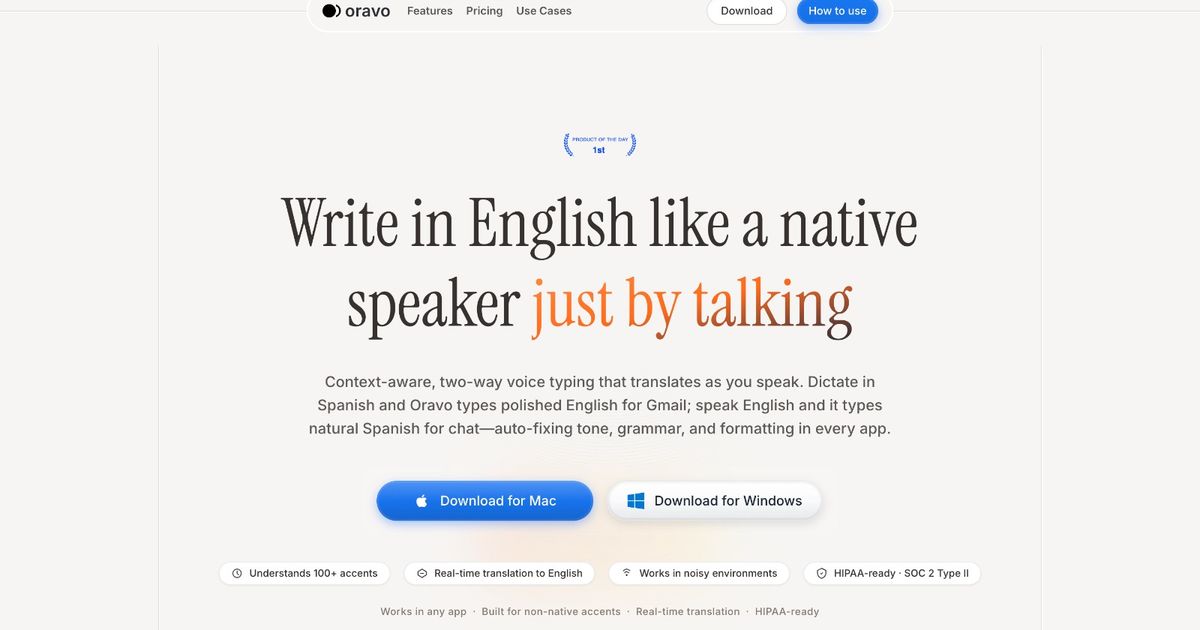
To use voice typing for research, apply it at four specific stages: capturing initial ideas and observations by voice, dictating literature notes after reading sources, producing spoken first drafts of sections, and dictating revisions and responses to reviewer comments. Voice typing is fastest when used to generate text, not to transcribe typed material. For non-native English researchers, Oravo converts naturally spoken input -- including accented English and mixed-language thinking -- into clean academic prose, removing the correction loop that makes standard dictation tools impractical for formal research writing.
Why Researchers Are Underusing Voice Typing
Research writing is one of the slowest categories of professional writing. Not because researchers are poor writers -- many are excellent. But because the cognitive demands of academic writing are high: precise argument structure, accurate citation, careful hedging of claims, adherence to field-specific conventions, and the production of prose that is simultaneously rigorous and readable.
Under that cognitive load, typing becomes a bottleneck. The physical act of converting thought to text slows the generation of ideas. Writers pause mid-thought to find the right word. They re-read and revise as they go. A paragraph that should take five minutes to draft takes twenty because the simultaneous demands of thinking and typing under academic quality standards are genuinely difficult to meet at speed.
Voice typing removes the typing bottleneck without removing the thinking requirement. You still have to know what to say. You still have to structure the argument. You still have to choose the right evidence. But the conversion of that thinking into written words happens at speaking speed -- three times faster than typing.
The researchers who use voice typing consistently produce more, revise less, and experience less writing fatigue. This guide covers how to implement voice typing at every stage of a research project.
Where Voice Typing Fits in the Research Workflow
Voice typing is not equally useful at every stage of research writing. Understanding where it delivers the most value and where it is less appropriate helps you integrate it into your workflow without friction.
High-value stages for voice typing:
Capturing initial ideas and observations in the moment. Dictating literature notes after reading a source. Producing first-draft section content. Responding to reviewers' comments. Dictating revisions to existing sections that need significant reworking.
Lower-value stages for voice typing:
Formatting citations and references (this is mechanical work better handled by citation management software). Editing sentence-level prose for precision and style (editing requires reading, re-reading, and deliberate word choice that is faster to do with a keyboard). Inputting tables, figures, or data (numerical and structural content is best entered by keyboard).
The pattern is consistent: voice typing excels at generating text from ideas. It is less suited to the mechanical and precision-editing tasks that are also part of research writing. Use it deliberately for generation and handle the rest with your keyboard.
Stage 1: Capturing Research Ideas by Voice
The first application of voice typing in a research workflow is the simplest and most immediately valuable: capturing ideas the moment they occur.
Research thinking does not happen only at a desk. Ideas come during a commute, during a break between experiments, while reading a paper, in the shower at 7am, walking between buildings on a campus. Most of these ideas are lost because the friction of opening a notes app and typing them out is just high enough that it does not happen consistently.
Speaking a note is lower friction than typing one. Open a voice memo app, speak the idea, and it is captured. With Oravo on a mobile or desktop browser, speaking a note into a research document is fast enough to happen in the moment rather than being deferred until you are at your desk.
How to build a spoken idea capture habit:
Keep a running research ideas document open in a browser tab throughout the day. When an idea occurs -- a new angle on your argument, a connection to a source you read, a methodological question, a gap in your current thinking -- activate Oravo and speak it. Three to five sentences spoken in the moment are more valuable than a detailed typed note written two hours later from a half-remembered idea.
Speaking ideas as they occur also has a secondary benefit: the verbal articulation of an idea often reveals whether it is fully formed. Ideas that sound clear in your head but come out garbled when spoken are ideas that need more development. Ideas that come out clearly when spoken are ready to write.
Stage 2: Dictating Literature Notes
Reading research literature is the stage of a research project where the most notes are generated and where the most time is wasted on mechanical note-taking.
The typical literature review workflow: read a paper, stop, type a summary of the key points, note the citation, highlight the relevant quote, note how it relates to your argument. Repeat for 50 to 200 papers. The note-taking alone can take as long as the reading.
Voice typing changes this workflow at the note-taking step.
The spoken literature notes workflow:
Read the paper on one screen. When you finish a section or reach a key point, activate Oravo in your notes document and speak your reaction: "Sharma et al. argue that X, which supports my position on Y but complicates the claim I make in section 3. Their methodology is interesting -- they used Z approach which I could reference when defending my own methodology. Potential citation for the literature review section where I discuss..."
Speaking your notes rather than typing them produces several things simultaneously: a summary of the source, your analytical reaction to it, its relationship to your argument, and a note on where it might be used. This analytical commentary is more valuable than a simple typed summary because it does the thinking work that the literature review will require, at the moment when the thinking is most natural and most connected to the source.
The citation note: Speak the author, year, and key claim clearly so Oravo transcribes an accurate reference you can verify later. "Sharma et al. 2023 -- the main argument is that..." gives you a searchable reference point even before you add the full citation to your reference manager.
Stage 3: Dictating Research Section Drafts
This is the stage where voice typing delivers the most dramatic time saving for researchers: the production of first-draft section content.
Research writing has a reputation for being slow. Partly this is because academic writing standards are high and the thinking required to meet them is genuinely difficult. But a significant part of research writing slowness is the simultaneous demand of thinking and typing -- the cognitive load of generating an idea and encoding it in typed text at the same moment.
Voice typing separates these demands. You think, then you speak. The speaking captures the thinking without requiring the typing. You move at the speed of your thinking rather than the speed of your fingers.
The pre-draft spoken outline for each section
Before dictating a section, spend three to five minutes dictating a spoken outline of that section. What is the main argument of this section? What evidence supports it? What counterargument needs to be addressed? What does this section establish for the next section?
Speaking this outline takes less than five minutes and produces a 200 to 400 word roadmap that guides the section dictation. Without this outline, section dictation tends to wander. With it, the dictation has direction and the sections are more coherent from the first draft.
The dictation itself
Activate Oravo in your research document. Position your cursor at the start of the section. Begin speaking the section content using your spoken outline as a guide.
Speak in academic register as naturally as you can, but do not try to produce final academic prose. The goal of first-draft dictation is to get the argument, the evidence, and the structure onto the page. The precise language, the hedging, the specific phrasing that academic writing requires -- these are refined in the editing stage. Trying to produce final academic prose while speaking produces slow, halting dictation that negates the speed advantage.
Oravo's professional English refinement layer converts naturally spoken academic-register English into clean, formal prose. "Basically what we are arguing here is that the data shows a significant relationship between X and Y which suggests that..." becomes "The data indicate a significant relationship between X and Y, suggesting that..." The argument is preserved. The register is elevated. The first draft is usable.
For non-native English researchers specifically
The challenge of writing research in English as a non-native speaker is well-documented. The pressure to meet the language standards of international academic journals while simultaneously managing the intellectual demands of research produces writing that is often correct but stilted -- the result of carefully monitored, second-guessed prose production rather than natural academic communication.
Voice dictation with Oravo changes this dynamic. You speak the argument in the English that comes naturally -- which may include L1 grammar patterns, code-switching into your native language when a concept arrives faster in that language, and informal register that you would normally translate into academic English before it left your fingers. Oravo handles the translation to academic English register automatically.
The output is not final prose. Academic writing always requires multiple editing passes. But the first draft is dramatically better than what standard dictation tools produce from non-native English speech, and the process of producing it is dramatically less exhausting than trying to generate monitored, formal, second-language academic English by typing.
Stage 4: Dictating Responses to Reviewer Comments
Peer review is one of the most demanding writing tasks in academic life: you receive detailed criticism of your work, you have to respond to each point substantively, and you have to revise your manuscript accordingly -- all under a deadline with a word limit on your response letter.
Voice typing is particularly valuable here for two reasons.
First, the emotional intensity of responding to reviewer criticism makes typed composition slower than usual. The cognitive overhead of managing frustration, self-doubt, or defensiveness while also trying to compose formal academic prose is real and slows output. Speaking a response -- particularly speaking it in a conversational, frank mode that Oravo then converts to formal academic language -- separates the emotional processing from the formal composition. You speak what you actually think about the reviewer's comment. Oravo produces what you would have written after composing yourself.
Second, the volume of a typical reviewer response letter -- addressing 10 to 30 comments in detail, with references to specific manuscript locations and changes -- is high enough that the speaking speed advantage is significant. A response letter that might take four to six hours to type can be drafted in ninety minutes by dictation.
The spoken reviewer response workflow:
Create your response document. For each reviewer comment, activate Oravo and speak your response: "The reviewer asks about X. This is a valid concern that we address in the revision by... We have added a paragraph in section 3 that clarifies... We respectfully disagree with the suggestion that... because the data show..."
Oravo converts the spoken response to formal academic language. You then revise the manuscript section referenced in the response, and dictate the "Changes Made" note in the response letter.
Stage 5: Dictating Revisions to Existing Sections
When significant revision of an existing section is required, voice typing offers an approach that many researchers find more effective than trying to edit typed prose on screen.
Print or display the section to be revised. Read it completely. Then activate Oravo in a new document and dictate the revised version by speaking, using the existing section as a structural reference but allowing yourself to completely rewrite rather than patch.
Dictating a full rewrite of a section often produces a cleaner, more coherent result than trying to edit the existing text incrementally, because the incremental editing process tends to preserve original sentence structures that might be the root cause of the section's problems. Starting fresh by speaking forces a reconstruction of the argument from its logic rather than from its existing verbal form.
Practical Setup for Research Voice Typing
The tool: Oravo through Google Docs in Chrome. Google Docs provides the cloud backup, version history, and collaborative features that research writing requires. Oravo works natively inside the Google Docs text field.
The microphone: A directional USB microphone or USB headset. Research writing often happens in libraries, shared offices, and laboratories with background noise. A directional microphone or headset significantly reduces background noise pickup and improves transcription accuracy in non-ideal environments.
The citation manager: Zotero, Mendeley, or similar reference management software handles citations separately from the voice typing workflow. Speak the author and year in your dictated text as a placeholder ("Sharma et al. 2023 argues...") and format the full citation in your reference manager separately.
The note structure: Keep three separate documents in your research project folder: spoken idea captures (unstructured, updated throughout the day), literature notes (one note per source, spoken immediately after reading), and the manuscript itself (structured drafting using the spoken literature notes as source material).
Frequently Asked Questions
Can voice typing handle academic vocabulary and field-specific terminology?
Common academic vocabulary -- methodology, hypothesis, empirical, theoretical framework, quantitative, qualitative, and similar terms -- is handled accurately. Highly specialized terminology specific to narrow subfields may produce occasional substitutions. The review pass after dictating each section is where these are caught and corrected. Proper nouns -- author names, institution names, specific study names -- should be verified in the review pass.
Will voice-dictated academic writing sound less formal than typed writing?
The first-draft output from Oravo in academic contexts is in formal written register rather than spoken register. The professional refinement layer specifically converts spoken input to written English standards. The editing stage handles the final calibration of formality, hedging, and precision that academic writing requires. Dictated academic writing does not inherently sound more informal than typed writing -- it sounds more direct, which is often an improvement over overly cautious academic prose.
Is it appropriate to use voice typing for a dissertation or thesis?
Yes. A dissertation or thesis is original research and original writing. Using a tool to assist in the writing process is no different from using word processing software, a spell checker, or a grammar tool. The ideas, the research, the arguments, and the writing decisions remain entirely the author's. Voice typing assists with the mechanical conversion of thought to text; it does not generate research or arguments. Check your institution's academic integrity guidelines if uncertain, but voice typing is generally treated as equivalent to any other writing assistance tool.
How do I handle sections that require precise quantitative language?
For sections with specific numbers, statistics, formulas, or precise quantitative language, dictate the surrounding prose naturally and use a placeholder for the precise value: "The correlation coefficient was [insert exact value from Table 2]." Then add the precise values from your data in the editing pass. Mixing precise quantitative data entry with flowing prose dictation slows both processes. Keep them separate.
Does voice typing work well for writing literature reviews?
Yes -- the literature review is one of the sections where voice typing delivers the most value. The literature review requires synthesizing many sources into a coherent narrative argument. If you have built your spoken literature notes as described in Stage 2, your literature review is largely already written in those notes. Dictating the literature review becomes a process of synthesizing and connecting the spoken notes you already have rather than starting from scratch.
What about languages other than English for international researchers?
Oravo is designed to output professional English from multilingual input. For researchers who work primarily in languages other than English and produce English-language publications, the code-switching support -- speaking partially in your native language and receiving English output -- is directly applicable to the research writing context. For researchers who need to write publications in languages other than English, Oravo is not the appropriate tool for those non-English publications.
The Bottom Line
Research writing is hard because the thinking is hard. Voice typing does not make the thinking easier. What it does is remove the mechanical bottleneck that slows the transfer of thinking to page, and specifically for non-native English researchers, it removes the exhausting overhead of monitored second-language formal prose production.
Used at the right stages -- idea capture, literature notes, first-draft sections, reviewer responses, section rewrites -- voice typing returns hours per week to the research work itself. The literature review that takes three weeks to type takes ten days to dictate. The discussion section that you have been avoiding because you cannot face the blank page takes forty minutes to speak once you know what you want to say.
The words you are not writing are not waiting for you to become a better typist. They are waiting for you to start speaking.
Start Dictating Your Research Today -- Free Trial
Works in Google Docs in Chrome. Setup in two minutes. Start speaking your next section today.