Telegram Voice Message Transcription (2026): What Premium Does and What It Misses
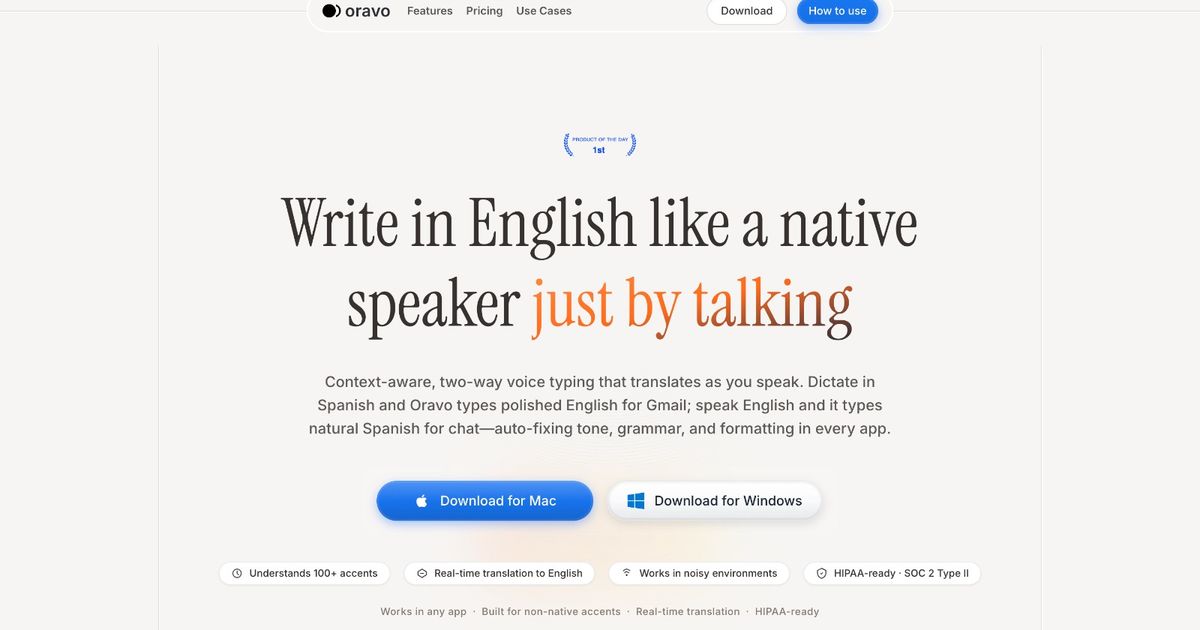
Telegram Premium includes voice message transcription that converts received voice messages into text automatically. As of 2026, this feature only transcribes messages sent to you -- it does not help you dictate or compose messages by voice. The transcription is raw and unedited, with no professional tone refinement and limited accuracy for non-native English accents. For professionals who want to send voice-dictated Telegram messages that arrive as clean, professional text, Oravo works inside Telegram Web in Chrome, converting spoken input into polished written messages before they are sent.
What Telegram Premium Voice Transcription Actually Is
Telegram Premium launched voice message transcription as one of its flagship paid features, and it generated significant buzz when it rolled out. The premise is appealing: instead of listening to a 90-second voice note, you read the transcript instead. Fast, searchable, accessible in silent environments.
The reality of the feature is narrower than the marketing implies, and understanding exactly what it does and does not do saves a lot of frustration for professionals who subscribed expecting something different.
What it does:
When someone sends you a voice message in Telegram, a small text icon appears below the audio waveform. Tap it and the voice message is transcribed into text displayed below the audio player. You can read instead of listen. The transcript is searchable within the chat. On Premium, this happens for all voice messages received.
What it does not do:
It does not transcribe messages you send. It does not help you compose messages by voice. It does not improve the accuracy of the transcription for non-native English accents. It does not clean up or refine the spoken content into professional written language. It does not work in group chats on all tiers. It is a received-message reading tool, not a voice input tool.
For the professional who wants to dictate a Telegram message and have it arrive as clean written text -- which is what most people imagine when they think "Telegram voice to text" -- Telegram Premium's transcription feature does not address that need at all.
The Two Distinct Use Cases Telegram Professionals Actually Have
The confusion around Telegram voice transcription comes from conflating two different needs that look similar on the surface but require completely different solutions.
Use case one: Transcribing voice messages you receive.
You are in a busy group chat. A colleague sends a 2-minute voice note. You are in a meeting and cannot listen. You want to read what they said instead of listening later. This is exactly what Telegram Premium's transcription feature addresses. It converts their spoken message into readable text for you.
Use case two: Composing and sending written messages by voice.
You want to dictate a message instead of typing it. You speak, and the text appears in the Telegram message field, ready to review and send. This is what most professionals mean when they search for "Telegram voice to text." Telegram Premium does not address this use case at all.
Most of this article is about the second use case -- composing messages by voice -- because that is where the gap in Telegram's offering is largest and where the need for a third-party solution is most acute.
Telegram Premium Transcription: An Honest Accuracy Assessment
For the use case it actually covers -- transcribing received voice messages -- Telegram Premium's transcription quality deserves honest evaluation rather than either dismissal or uncritical praise.
Accuracy for standard English:
For clear speech in a standard American or British accent in a quiet recording environment, Telegram's transcription is reasonably accurate for conversational messages. Short to medium-length voice notes with common vocabulary transcribe with acceptable accuracy for the purpose of getting the gist of the message.
Accuracy for non-native English accents:
This is where the feature falls short for a large portion of Telegram's global user base. Telegram is used heavily in South Asia, Southeast Asia, the Middle East, Eastern Europe, and Latin America -- regions where non-native English accents are the norm in professional communication. The transcription model underlying Telegram Premium's feature produces measurably higher error rates on these accent profiles.
A voice message from a colleague in Mumbai or Lagos or Manila -- speaking clearly and professionally -- may transcribe with enough errors to require listening to the audio anyway to understand the intended meaning. At that point, the feature has not saved time; it has added a step.
Accuracy for Hinglish, Spanglish, and other code-switching:
Voice messages in Hinglish or other code-switching modes produce unreliable transcription. Hindi words produce phonetic approximations in Roman script or are simply omitted. The result is a transcript with gaps that makes understanding the message harder, not easier.
The punctuation and formatting problem:
Telegram's transcription outputs a flat block of text with minimal punctuation. A 90-second voice message transcribes as one or two long run-on sentences with occasional automatic punctuation that is inconsistently applied. Reading a dense block of transcribed speech is faster than listening but significantly harder to parse than properly punctuated written text.
Why Telegram Has No Native Voice Composition Feature
Unlike WhatsApp -- which added a voice note transcription feature that works similarly to Telegram's -- and unlike some email clients that are experimenting with voice composition, Telegram has not added a native feature for composing messages by voice.
The technical reason is that voice composition requires integration with the device's speech recognition system at a level that Telegram's messaging interface does not currently expose. Voice messages in Telegram are audio recordings sent as audio files. Dictated text messages would require a speech-to-text pipeline integrated into the text input field -- a different technical implementation that Telegram has not built.
The practical implication is that professionals who want to use their voice to compose Telegram messages need a workaround. The two available approaches are OS-level dictation tools and browser-based dictation layers.
How to Actually Dictate Telegram Messages: Every Method
Method 1: Keyboard Microphone (Gboard or iOS Keyboard)
On mobile, every keyboard has a microphone icon. Tap it, speak, and the recognized text appears in the Telegram message field. This is the most widely used approach and requires no additional setup.
What it does well: Zero friction. Works immediately on any smartphone with Telegram installed. For short, casual messages in standard English, it is fast enough.
Where it fails: Raw transcription. Your spoken words -- filler words, grammar patterns from your native language, accent-related errors -- all appear in the message field. For casual conversation with close contacts, this is acceptable. For professional Telegram communication with colleagues, clients, or business contacts, unedited keyboard dictation output is often not appropriate to send without correction.
For non-native English speakers, the keyboard microphone on mobile uses the standard OS speech recognition engine, which produces higher error rates on non-standard accents and no professional refinement of the output.
Method 2: Windows Voice Typing or Apple Dictation (Desktop)
On desktop, Telegram can be accessed through the Telegram desktop application or through Telegram Web in a browser. OS-level dictation tools work in both.
Windows Voice Typing (Win + H): Works in the Telegram desktop app and Telegram Web. Activates a floating dictation bar, types recognized speech into whatever text field is active.
Apple Dictation (fn fn on Mac): Works system-wide including in Telegram desktop and Telegram Web on Mac.
The limitation: Same as keyboard dictation -- raw transcription. What you say goes into the Telegram message field as spoken. Professional messages require manual correction before sending.
Method 3: Oravo Through Telegram Web in Chrome (Recommended for Professional Use)
Telegram Web -- accessed at web.telegram.org in Chrome -- is a full-featured browser-based interface for Telegram that supports Oravo's voice dictation layer. This is the approach that closes the gap between speaking speed and professional message quality for Telegram.
How it works:
Open Telegram Web (web.telegram.org) in Chrome. Navigate to any chat. Click the message input field. Activate Oravo. Speak your message naturally. Oravo's processed output appears in the Telegram message field as clean, professional text. Review and send.
What Oravo adds to the Telegram workflow:
The accent-aware transcription layer handles non-native English input with higher accuracy than the standard speech recognition engines underlying keyboard dictation and OS-level tools. The professional English refinement layer converts naturally spoken input -- with its filler words, informal constructions, and L1 grammar patterns -- into polished professional English ready to send without manual correction.
For a professional using Telegram for business communication -- supplier conversations, client updates, team coordination across borders -- the quality difference between keyboard dictation output and Oravo output is the difference between a message that might be sent as written and a message that requires editing before it represents you professionally.
The Hinglish and code-switching use case:
For Indian professionals using Telegram -- one of the largest Telegram user bases globally -- the ability to dictate in Hinglish and receive clean English output is specifically valuable. A message dictated as "yaar the client ne bola hai ki proposal Friday tak chahiye -- koi issue?" becomes "The client has requested the proposal by Friday -- please let me know if there are any issues." The code-switch is resolved. The message is professional. The time to compose and send is under 30 seconds.
Comparing the Voice Transcription Options for Telegram
Approach
What it covers
Accent accuracy
Professional output
Setup
Telegram Premium transcription
Received voice messages only
Moderate -- struggles with non-native accents
No -- raw transcript
Telegram Premium subscription
Keyboard microphone (mobile)
Composing messages by voice
Moderate -- standard OS ASR
No -- raw transcription
Zero -- built in
Windows Voice Typing / Apple Dictation
Composing messages by voice (desktop)
Moderate -- standard English optimized
No -- raw transcription
Zero -- built in
Oravo through Telegram Web
Composing messages by voice (desktop Chrome)
Excellent -- accent correction built in
Yes -- full professional refinement
Two minutes
Who Actually Needs Better Telegram Voice Transcription
International business teams using Telegram for coordination
Telegram is used as a business coordination tool across many emerging markets where WhatsApp dominates consumer communication but Telegram's group features, file sharing, and channel capabilities make it preferable for professional teams. Indian startups, Southeast Asian businesses, Middle Eastern companies, and Eastern European teams use Telegram extensively for internal coordination.
For professionals on these teams composing messages by voice, the quality of the dictated output matters in a professional context. Keyboard dictation producing unedited transcription of non-native English speech is not appropriate for client-facing or management-facing Telegram communication.
Professionals in high-message-volume roles using Telegram
Community managers, customer support professionals, sales coordinators, and anyone managing multiple active Telegram conversations benefits from voice composition speed. At 30 to 50 messages per day in Telegram, the time saved by dictating instead of typing is 20 to 40 minutes -- provided the dictation output is clean enough to send without extensive correction.
Non-native English professionals managing Telegram channels
Telegram channels used for professional broadcasting -- product updates, industry news, team announcements -- require polished written content. Channel administrators who are non-native English speakers and who manage high-frequency channel publishing benefit from Oravo's refinement layer to maintain consistent professional quality across posts without the writing overhead of careful manual composition.
The Telegram Premium Decision: Is It Worth It for Voice Transcription?
Telegram Premium costs approximately $5 per month and includes a bundle of features beyond voice transcription: faster downloads, exclusive stickers, no ads in public channels, increased file upload size, and others. Voice transcription of received messages is one feature among many.
If your primary reason for considering Telegram Premium is voice transcription, the honest assessment is: it depends on how you use voice messages.
Premium transcription is worth it if: You receive many voice messages from people who record rather than type, and you frequently need to read rather than listen (meetings, noisy environments, situations where audio is not appropriate). The feature works well enough for standard English voice messages to be genuinely useful for this purpose.
Premium transcription is not worth it if: Your primary need is dictating your own messages by voice. The feature does not address this use case. For voice composition, Oravo through Telegram Web addresses the need that Premium transcription ignores.
The combination worth considering: Telegram Premium for receiving and reading voice messages from others, plus Oravo through Telegram Web for composing professional messages by voice. Both use cases covered, both tools doing what they are each designed to do.
Frequently Asked Questions
Does Telegram Premium transcription work for all languages?
Telegram Premium transcription supports a number of languages beyond English, including Spanish, Portuguese, Russian, and others. The accuracy varies by language and accent. For English, the accuracy is better for standard American and British accents than for non-native English accents. For heavily accented English, the transcription quality is often insufficient to replace listening to the audio.
Can Telegram transcribe voice messages without Premium?
In 2026, the voice message transcription feature in Telegram requires a Premium subscription or is available to all users in chats where at least one user has Premium (the exact availability has varied by update). Non-Premium users in some contexts can access transcription through another user's Premium status in a shared chat.
Why does Telegram transcription sometimes produce nonsense text for certain accents?
Telegram's transcription engine, like most general-purpose speech recognition models, was trained predominantly on majority accent profiles. Strong regional accents -- particularly from South Asia, West Africa, and Southeast Asia -- produce higher error rates because the phonological patterns of those accents are underrepresented in the training data. The result can be transcription that is partially or completely wrong for the intended words, requiring the listener to play the audio to understand the message.
Does Oravo work in the Telegram mobile app?
Oravo is browser-based and works in Telegram Web accessed through Chrome on desktop. It does not integrate with the native Telegram iOS or Android application. For mobile Telegram voice composition, the keyboard microphone is the available option. For desktop Telegram professional communication, Oravo through Telegram Web is the recommended approach.
Is there a way to automatically transcribe all Telegram voice messages I receive without Premium?
Some third-party bots and integrations claim to transcribe Telegram voice messages without Premium. These vary in reliability, accuracy, and privacy implications -- voice message audio is sent to a third-party server for processing. For privacy-conscious professionals, reviewing any such service's data handling before use is important. Telegram Premium's transcription processes audio within Telegram's own infrastructure.
What is the difference between Telegram voice messages and Telegram voice chats?
Voice messages in Telegram are recorded audio files sent in a chat, similar to WhatsApp voice notes. Voice chats are live audio rooms within Telegram groups, similar to Discord voice channels or Twitter Spaces. Telegram Premium's transcription feature applies to recorded voice messages, not to live voice chats.
The Bottom Line
Telegram Premium's voice message transcription is a useful feature for a specific use case: reading received voice messages instead of listening to them. For standard English voice messages in quiet recording conditions, it works well enough to save time. For non-native English accents, code-switching messages, and long rambling voice notes, its usefulness drops significantly.
For the use case that most professionals actually want -- composing and sending professional-quality Telegram messages by voice -- Telegram Premium does nothing. That gap is real and currently unaddressed by Telegram's own feature set.
Oravo through Telegram Web fills that gap for professionals who use Telegram for business communication and need the combination of speaking speed and professional output quality that keyboard dictation and OS-level dictation tools do not provide.
Telegram transcription tells you what someone said. Oravo helps you say it better, faster.
Start Composing Telegram Messages by Voice -- Free Trial
Open web.telegram.org in Chrome. Go to oravo.ai in another tab. Create your free account. Activate Oravo in any Telegram message field and start dictating.