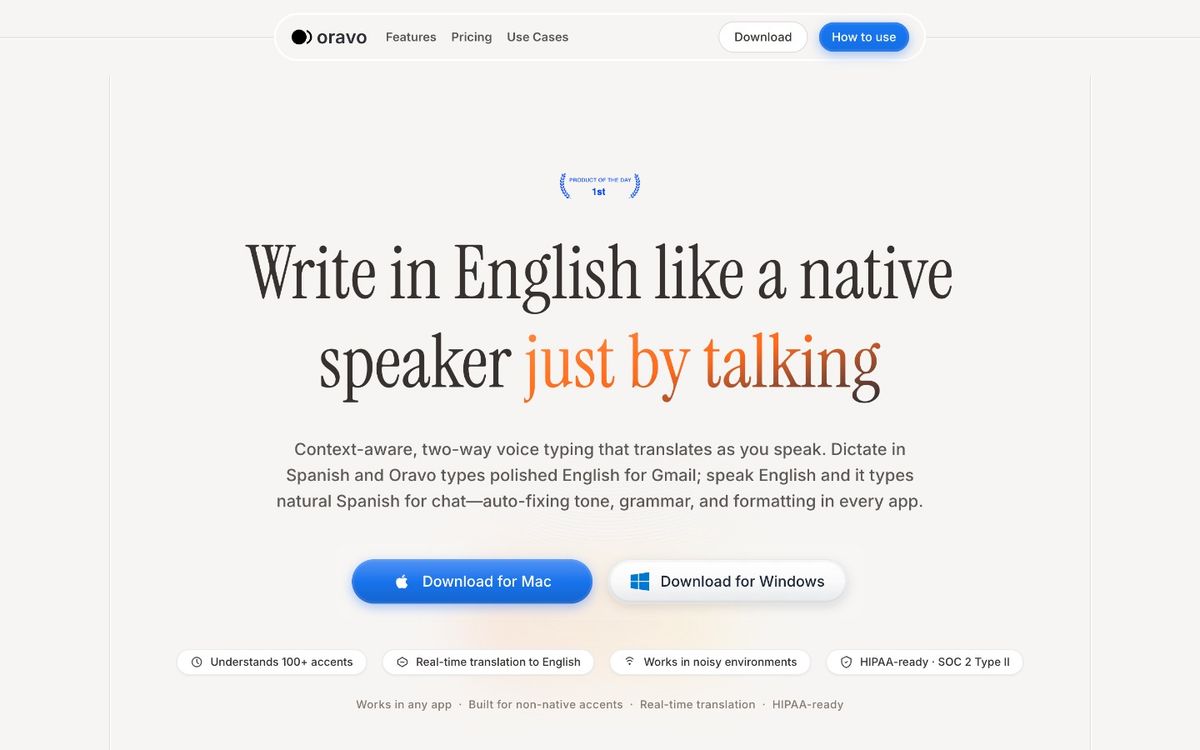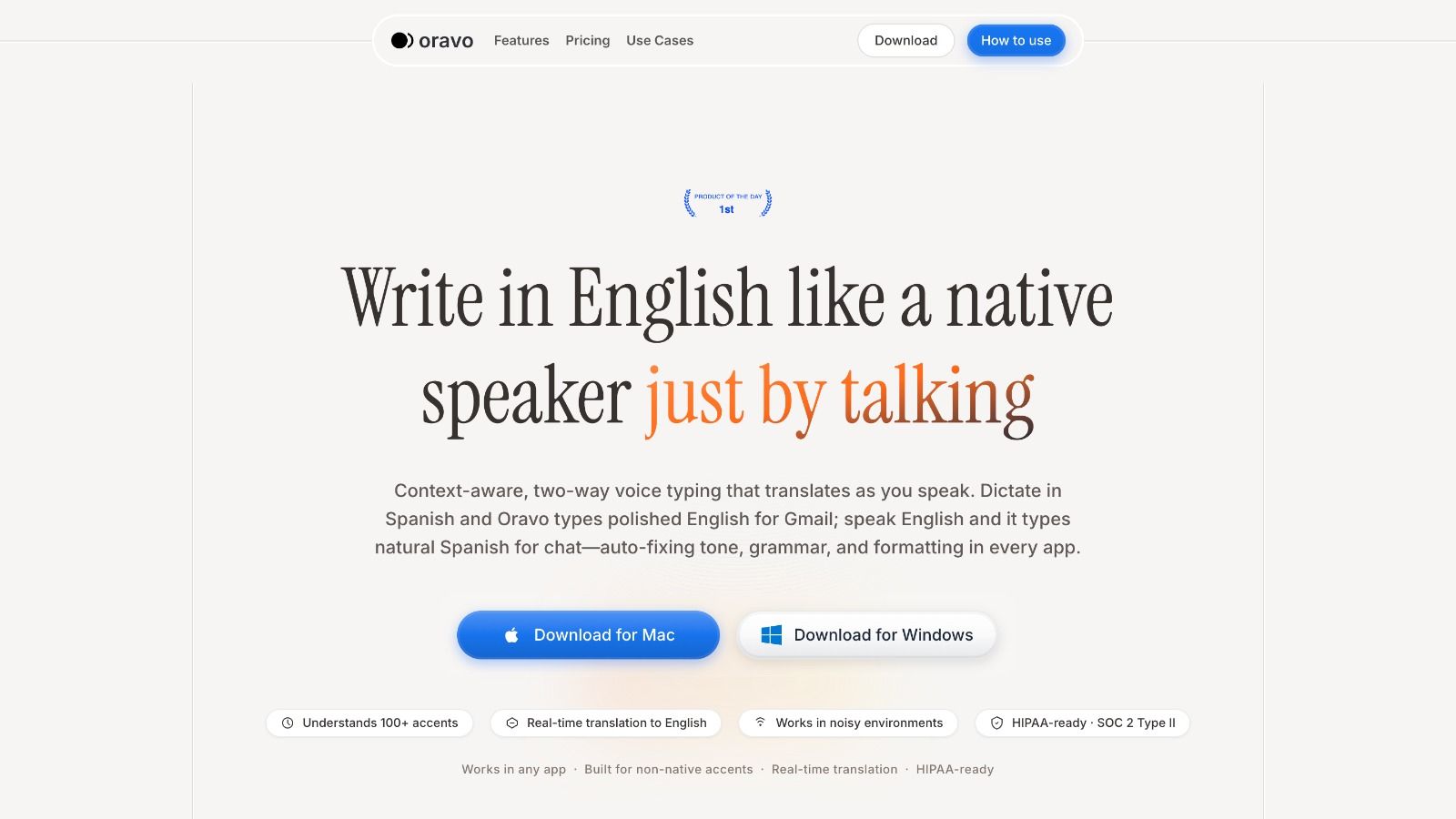
Most mainstream speech recognition tools were trained predominantly on American and British English accents and perform significantly worse on Indian English. The best speech recognition tools for Indian accents in 2026 are Oravo, Google Speech-to-Text, Microsoft Azure Speech, and Whisper (OpenAI). For Indian professionals who need more than raw transcription -- clean, professional English output from naturally spoken Indian English or Hinglish -- Oravo is the only tool that combines accent-aware recognition with a professional refinement layer that handles the specific patterns of Indian English speech.
The Indian Accent Problem in Speech Recognition: What Is Actually Happening
If you are an Indian professional who has used voice typing and found yourself spending more time fixing errors than you saved by not typing, you already know there is a problem. What you may not know is exactly why it happens -- and why it is not going to fix itself if you just "speak more clearly."
The problem is not your accent. The problem is that the tools you are using were trained on someone else's voice.
Speech recognition models learn from data. The accuracy a model achieves on any given accent is a direct function of how much speech in that accent was included in its training data. American English dominates the training sets of virtually every major commercial speech recognition system. British English is well-represented. Indian English -- spoken by over 125 million people as a first or second language, and by hundreds of millions more as a working language -- is underrepresented in most commercial training corpora relative to its actual global usage.
The result is a structural accuracy gap that no amount of careful enunciation will fully close. You can slow down, you can soften your accent, you can speak in a way that feels unnatural to you -- and you will still see higher error rates than a native American or British English speaker using the same tool in the same conditions.
This is not a personal failure. It is a product failure. And it is one that the speech recognition industry has been slow to address because the users most affected are not the users who were centered in the product design process.
Why Indian English Is Genuinely Difficult for Standard Speech Recognition Models
Indian English is not a single accent. It is a family of accents shaped by the linguistic background of the speaker -- Hindi speakers, Tamil speakers, Bengali speakers, Telugu speakers, Kannada speakers, Marathi speakers, and dozens of others all produce distinct varieties of Indian English with different phonological patterns.
Understanding why these accents challenge standard models requires understanding what the models are actually doing.
Phonological differences
Indian English has several systematic phonological features that differ from the American and British English patterns that most models are tuned to. Retroflex consonants -- the T, D, and N sounds produced with the tongue curled back -- are a distinctive feature of many Indian English accents that standard models were not trained to expect. The aspiration patterns of consonants differ. Vowel length and quality follow different rules. The rhythm of Indian English tends toward syllable-timing rather than the stress-timing of most American and British speech, which affects how words land in the acoustic space the model is analyzing.
None of these features make Indian English harder to understand for a human listener familiar with it. They make Indian English harder to transcribe for a model trained without sufficient exposure to it.
Vocabulary and usage patterns
Indian English includes a substantial set of vocabulary, phrases, and usages that are standard within Indian professional contexts but absent from or rare in the training data of American-trained models. "Do the needful." "Prepone the meeting." "Out of station." "Revert back." "Kindly." These are not errors -- they are Indian English. But a model trained on American corpora treats them as anomalies and sometimes produces substitutions or simply fails to transcribe them correctly.
Code-switching and Hinglish
A significant portion of Indian professionals naturally mix Hindi and English in their spoken communication. Hinglish -- the fluid blending of Hindi vocabulary and grammar with English structure and vice versa -- is not a degraded form of either language. It is a fully functional communicative mode used by hundreds of millions of people daily.
Standard speech recognition models do not handle Hinglish. When a speaker switches to a Hindi word mid-sentence, most models either produce a phonetic approximation in English letters, skip the word entirely, or produce gibberish. The result is a transcript with holes and errors in precisely the places where the speaker's natural communication was most fluent.
Speaking rate and prosody
Indian English often has a faster speaking rate than the slower, more deliberate speech that produces the best results in most speech recognition systems. The rhythm and intonation patterns that convey emphasis and meaning in Indian English are different from the patterns the models learned to interpret from American or British speech. These prosodic differences contribute to recognition errors that are difficult to predict or systematically avoid.
How Indian Accent Errors Actually Show Up: A Taxonomy of What Goes Wrong
Understanding the specific error patterns that Indian accent speech recognition produces helps set expectations and clarifies why a refinement layer matters as much as transcription accuracy.
Word substitution errors
The most common error type. The model mishears a word and substitutes a phonetically similar word that makes no sense in context. "Feasibility" becomes "visibility." "Prepone" becomes "prone" or simply fails. "Fortnight" becomes "for night." These errors are dangerous because they are plausible-looking -- they pass a quick visual scan but change the meaning of the message.
Proper noun failures
Indian names, place names, company names, and product names that are not in the training vocabulary of an American-trained model produce high error rates. A name like "Suresh Krishnamurthy" or "Thiruvananthapuram" or "Infosys" may be transcribed correctly on well-tuned commercial APIs but fails frequently on consumer voice typing tools. For a professional whose daily communication involves Indian names and organizations, this is a constant source of manual correction.
Article and preposition omission
Several major Indian languages -- Hindi, Tamil, Telugu, Kannada -- do not use articles (a, an, the) the way English does. This produces a consistent pattern in the English speech of speakers from these language backgrounds: articles are sometimes omitted in fast speech. "I will send report by tomorrow" instead of "I will send the report by tomorrow." Standard models transcribe what they hear, which may or may not include the omitted article. The result is English that reads as non-native even when the spoken input was perfectly clear to any human listener.
Retroflex substitution
The retroflex consonants that characterize many Indian English accents cause models to occasionally substitute standard alveolar consonants, producing transcription errors that are difficult to anticipate. The word "better" pronounced with retroflex T sounds may be transcribed as "bedder" or simply produce a low-confidence substitution.
Hinglish transcription breakdown
As described above, any Hindi word in a Hinglish utterance is a potential transcription failure point. The model either guesses phonetically -- producing something that resembles neither the Hindi word nor any English word -- or it skips the word, leaving a gap in the transcript.
The Tools: Honest Evaluation for Indian Accent Users
Google Speech-to-Text -- The Baseline, with Real Limits
Google's speech recognition is the engine powering Gboard voice typing, Google Docs voice input, Google Assistant, and many third-party applications. It is the most widely used speech recognition system in India by a significant margin simply because it comes pre-installed on Android devices.
Where Google does well for Indian accents
Google has invested meaningfully in Indian English language support. The Indian English model (en-IN) is distinct from the standard American and British models and performs noticeably better on Indian accent input than the generic English model does. For standard vocabulary Indian English in a relatively quiet environment, Google's en-IN model produces acceptable accuracy for casual use.
Google also has the advantage of having collected substantial Indian English voice data through its products' usage in India, which has contributed to model improvements over time.
Where Google falls short for Indian accent users
The en-IN model improvement over the generic model is real but not transformative. For professionals who need reliable accuracy on fast speech, diverse vocabulary, code-switching, and proper noun recognition, the error rate is still high enough to require systematic manual correction.
More critically, Google's speech recognition output -- regardless of accuracy level -- is raw transcription. There is no layer that converts spoken Indian English patterns into standard professional English. "Please do the needful" stays as "please do the needful." "I will revert back to you at earliest" stays exactly as spoken. The accuracy question and the professional output quality question are separate, and Google only addresses the first.
Google Speech-to-Text summary for Indian accent users
- Accuracy on Indian accents: Moderate -- better than generic English model with en-IN; still below professional reliability threshold
- Hinglish support: Poor -- Hindi words produce high error rates
- Professional English output: No -- raw transcription only
- Best for: Casual short-form dictation in standard Indian English; Android system-wide dictation where convenience outweighs quality
- Not recommended for: Professional communication requiring polished output; Hinglish speakers; fast speech with diverse vocabulary
Microsoft Azure Speech -- The Enterprise Option with Indian English Support
Microsoft Azure Speech Services includes explicit Indian English support in its language models and is used by enterprise applications, contact centers, and business productivity tools across India. It is not a consumer product -- it is an API that developers and enterprises integrate into their own applications.
Where Azure Speech performs well
Azure's Indian English model performs better than most consumer-grade alternatives on standard Indian English input. Microsoft has invested in Indian English support specifically for the enterprise market, and the accuracy improvements are genuine. For enterprise applications built on Azure, the Indian English model is a meaningful upgrade over a generic English model.
Azure also supports Hindi speech recognition separately, which makes it relevant for applications that need to handle Hindi-language input specifically rather than Hinglish code-switching.
Where Azure Speech falls short for individual professionals
Azure Speech is not a consumer product and is not directly accessible to an individual professional looking for a voice typing tool. It requires API integration and development work to use. An individual in Bangalore or Mumbai cannot install Azure Speech the way they can install Oravo or use Gboard.
Like every other tool in this comparison except Oravo, Azure Speech provides transcription without a professional output refinement layer. Clean transcription of Indian English is a better input than inaccurate transcription -- but it still leaves the gap between spoken Indian English patterns and professional written English unclosed.
Azure Speech summary for Indian accent users
- Accuracy on Indian accents: Good -- dedicated en-IN model with enterprise-grade tuning
- Hinglish support: Limited -- Hindi and English handled separately; code-switching not natively supported
- Professional English output: No -- transcription only
- Best for: Enterprise applications and contact center platforms built on Microsoft infrastructure
- Not recommended for: Individual professionals; consumer-grade daily use; Hinglish speakers
OpenAI Whisper -- The Highest Offline Accuracy, Still Raw Transcription
Whisper is OpenAI's open-source speech recognition model and, for Indian English specifically, represents a significant step forward in offline accuracy. Whisper was trained on a large-scale multilingual dataset that included substantially more non-native English speech than the datasets used to train most commercial consumer tools.
Where Whisper performs well on Indian accents
The large and medium Whisper models handle Indian English accents with meaningfully better accuracy than standard consumer voice typing tools. The retroflex consonants, the prosodic patterns, the faster speaking rate -- Whisper's diverse training data gives it a better baseline for these features than Google's consumer models.
Whisper also has genuine multilingual capability. It can transcribe Hindi speech accurately, and its English translation mode can take Hindi speech and output English text. For users who speak Hindi and want English output, this is a functional capability that most other tools do not offer at all.
Where Whisper falls short for Indian professionals
Whisper is a transcription engine. It does not address the professional output quality gap. Spoken Indian English patterns -- the articles, the phrasings, the usages that are standard in Indian professional culture but read as non-native in a Western corporate context -- are transcribed faithfully, not refined.
Whisper also requires technical setup to use for real-time dictation. It was designed as a batch transcription tool and needs a custom pipeline for live voice typing use. The hardware requirements for the accuracy levels that make it worth using over simpler tools are significant -- a GPU is recommended for the large model.
Whisper summary for Indian accent users
- Accuracy on Indian accents: Excellent for offline models; best available open-source accuracy
- Hinglish support: Good -- multilingual capability handles Hindi components better than most tools
- Professional English output: No -- raw transcription only
- Best for: Technical users who can build a real-time pipeline; batch transcription of Indian English audio; highest offline accuracy with GPU hardware
- Not recommended for: Consumer daily-use dictation; professionals without technical setup capability; anyone who needs professional output refinement
Oravo -- Built for the Gap Between Indian English Speech and Professional English Writing
Every tool reviewed above addresses some portion of the Indian accent speech recognition problem. None of them address the full problem.
The full problem for an Indian professional is not just "the tool mishears my words." The full problem is: "I think in Hindi or another Indian language, I speak in Indian English, I need to produce professional corporate English, and every tool in the market handles the first step badly and ignores the second step entirely."
Oravo was built to address both.
The two-part solution
Oravo's approach to Indian accent speech recognition is built on two distinct layers that work together.
The first layer is accent-native transcription. Oravo's speech recognition models were trained on Indian English voice data as a first-class input, not as a supplementary category. The retroflex consonants, the syllable-timed rhythm, the intonation patterns, the vocabulary specific to Indian English -- these are not edge cases in Oravo's model. They are central to what the model was trained to handle. The result is higher baseline accuracy on Indian English input before any refinement takes place.
The second layer is professional English refinement. After transcription, Oravo processes the output through a professional tone and grammar layer that understands the specific patterns of Indian English and converts them to standard corporate English without changing the meaning.
"Please do the needful and revert at earliest" becomes "Please take care of this and get back to me at your earliest convenience."
"Kindly find attached the report as discussed" becomes "Please find the report attached, as discussed."
"I will look into the same and update you" becomes "I will look into this and keep you updated."
"We need to prepone the client call" becomes "We need to move the client call to an earlier time."
These are not corrections for errors. They are translations between two valid forms of English -- Indian professional English and standard corporate English -- that carry different signals to different readers in a global professional context.
Hinglish input, professional English output
The code-switching capability is the feature that distinguishes Oravo most sharply from every other tool in this comparison for the Indian professional market.
When a professional dictates in Hinglish -- which for hundreds of millions of Indian professionals is simply how they think when they are working fast -- Oravo recognizes the mixed input, extracts the meaning from both the English and Hindi components, and produces clean professional English output.
"Yaar, client ko kal tak proposal bhejna hai -- please dekh lena" becomes "Please ensure the proposal is sent to the client by tomorrow."
"Meeting ka time change karna hai, 3 baje karo" becomes "Please reschedule the meeting to 3 PM."
"Budget approve hua -- ab aage badh sakte hain" becomes "The budget has been approved -- we can proceed."
The speaker did not have to suppress their natural way of communicating. Oravo handled the translation from Hinglish to professional English automatically.
Who Oravo is built for within the Indian professional context
The Oravo user in India is the professional who writes more than they want to, faster than they can type well, in a language that is not their mother tongue, for audiences who may judge their professionalism on the quality of their written English.
That is a very large group. It includes software engineers writing documentation and Slack messages. It includes business analysts writing client-facing reports. It includes sales professionals writing proposals and follow-up emails. It includes managers writing performance reviews and stakeholder updates. It includes consultants writing recommendations and presentations.
For each of these professionals, the combination of Indian English accent accuracy and professional output refinement that Oravo provides changes the daily calculus of dictation from "is it worth the correction time" to "it is always worth it."
Oravo summary for Indian accent users
- Accuracy on Indian accents: Excellent -- first-class training data for Indian English; best accuracy for Indian accent input
- Hinglish support: Full -- code-switching recognition and resolution to professional English
- Professional English output: Yes -- full refinement layer converts Indian English patterns to standard corporate English
- Platform fit: Browser text fields -- Gmail, Slack, WhatsApp Web, Google Docs, and any other browser-accessible application
- Best for: Indian professionals writing professional communication in English daily; Hinglish speakers; anyone who needs clean output without a correction loop
- Not recommended for: Fully offline workflows; system-wide dictation outside browser applications
The Professional Stakes of Indian Accent Speech Recognition in 2026
This is worth saying directly because the voice dictation industry rarely does.
Indian professionals writing in English for global audiences are operating in an environment where written language quality is used -- consciously and unconsciously -- as a proxy for professional capability. An email with transcription errors that reflect Indian English speech patterns is not read as "this person used a voice typing tool that did not handle their accent well." It is read as "this person's English needs work."
That judgment is unfair. It conflates the quality of a software tool with the capability of the professional using it. But it is real, and ignoring it does not make it less consequential.
Every transcription error that passes through a voice typing tool into a professional email or Slack message is a small credibility event. Individually, each one is recoverable. Cumulatively, they shape impressions.
The Indian professionals who will benefit most from accurate, refined speech recognition output are not the ones who most need to improve their English. They are the ones who already command excellent professional English but are using tools that do not keep up with them.
Oravo does not exist to fix anyone's English. It exists to give Indian professionals a voice typing tool that finally matches the quality of what they actually want to communicate -- without the correction loop, without the errors, without the signal that the technology let them down.
Practical Recommendations: Which Tool for Which Use Case
Use case
Recommended tool
Android system-wide casual dictation; standard Indian English; short messages
Google Speech (en-IN via Gboard)
Enterprise application development for Indian English users
Microsoft Azure Speech (en-IN)
Offline transcription of Indian English audio; technical user with GPU
OpenAI Whisper (large model)
Professional email, Slack, and WhatsApp writing; Indian English or Hinglish speaker; needs clean output
Oravo
High-volume professional communication across Gmail, Google Docs, and messaging apps
Oravo
Any professional context where output quality affects client or stakeholder impression
Oravo
Frequently Asked Questions
Why is speech recognition less accurate for Indian accents?
Most commercial speech recognition models were trained predominantly on American and British English voice data. Indian English has distinct phonological features -- retroflex consonants, syllable-timed rhythm, different vowel patterns, different intonation -- that are underrepresented in these training sets. The result is higher error rates for Indian accent input than the tool's general accuracy figures suggest. This is a training data problem, not a speaker problem.
Does Google support Indian English in its speech recognition?
Yes. Google offers an Indian English language model (en-IN) that performs better on Indian accent input than the generic English model. It is available in Google's cloud Speech-to-Text API and is used in some Android dictation contexts. However, even the en-IN model has meaningful accuracy limitations for fast speech, Hinglish input, and professional vocabulary, and it provides no professional tone refinement.
What is Hinglish and can any speech recognition tool handle it?
Hinglish is the code-switching blend of Hindi and English used naturally by hundreds of millions of Indian professionals in daily communication. Most speech recognition tools cannot handle Hinglish -- they either produce errors on the Hindi components or skip them. Oravo is the only tool in this comparison that explicitly supports Hinglish input and produces clean English output from it.
Is there a speech recognition tool specifically built for Indian accents?
Most mainstream tools have Indian English as a supported language variant, but none of the major consumer tools were built specifically for Indian accents as a primary use case. Oravo's training data and refinement layer represent the most focused approach to Indian accent support currently available in a consumer-grade professional dictation tool.
How does professional tone refinement work for Indian English specifically?
Indian English has a set of phrases and usages that are completely standard in Indian professional culture but are read as non-native by readers from American or British professional backgrounds. Phrases like "do the needful," "revert back," "out of station," "prepone," and "kindly" are understood perfectly but carry an Indian English marker. Oravo's refinement layer identifies these patterns and replaces them with equivalent expressions in standard corporate English, so the meaning is preserved and the non-native signal is removed.
Can Oravo handle Indian regional English varieties -- not just standard Indian English?
Oravo's training data encompasses a broad range of Indian English accent profiles, not just the pan-Indian standard. Regional variations -- Tamil English, Bengali English, Telugu English, Marathi English -- are part of the accent diversity the model was designed to handle. No model handles all accent variation perfectly, but Oravo's accent corpus is substantially more inclusive of Indian English diversity than standard commercial alternatives.
Does using a voice refinement tool mean my English is not good enough?
No. Using Oravo or any professional refinement tool is a workflow efficiency decision, not a reflection of English proficiency. Surgeons use autocorrect. Native English-speaking executives use grammar checkers. The goal of professional writing tools is to reduce the cognitive overhead of communication so professionals can focus on the substance of what they are saying rather than the mechanics of how they are saying it. Oravo serves that purpose for Indian professionals the same way grammar and style tools serve it for any professional.
The Bottom Line
Indian accent speech recognition in 2026 is better than it was five years ago. It is not yet where Indian professionals need it to be.
The accuracy gap between Indian English input and what standard tools were trained to recognize has narrowed. It has not closed. And the professional output quality gap -- the distance between what Indian English sounds like when spoken naturally and what standard corporate English looks like when written -- remains unaddressed by every tool in this comparison except one.
Oravo addresses both. The transcription accuracy layer handles Indian English and Hinglish input with higher reliability than standard tools. The refinement layer converts that input into professional English output that meets global corporate communication standards without requiring the speaker to change how they speak or the professional to spend time on corrections.
For the 125 million Indian English speakers in the professional workforce, and for the hundreds of millions more who work in English daily, that combination is not a feature. It is what voice dictation should have always been.
Try Oravo Free -- Works in Your Browser, Understands Your Voice
No download. No complicated setup. Works in Gmail, Slack, WhatsApp, and Google Docs through your browser.
Start your free trial at oravo.ai
Speak the way you speak. Get output that reads the way you need to write.
Written by
Dipesh Bhatt
The Oravo team writes about voice typing, productivity and writing clear English when it is not your first language.